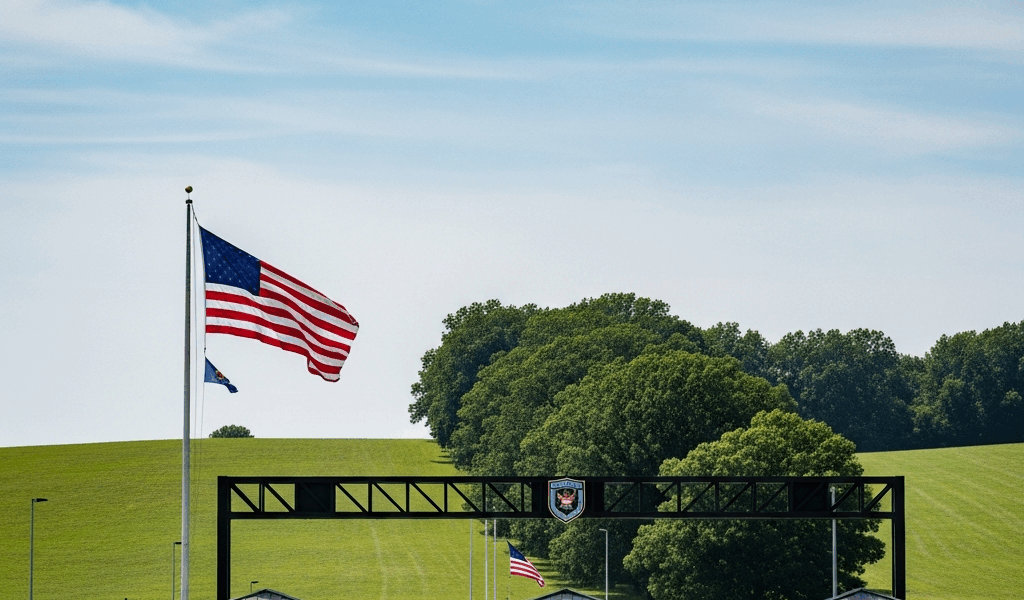
First Army headquarters is at Fort Knox, Kentucky. It relocated there from Rock Island Arsenal, Illinois in 2011 as part of the Base Realignment and Closure (BRAC) process. The command occupies facilities on the Fort Knox installation and oversees the training and readiness of the Army Reserve and Army National Guard — a mission most people outside the Reserve Component do not fully understand.
First Army Headquarters — Fort Knox, Kentucky
First Army’s headquarters is located on the Fort Knox military installation in Hardin County, Kentucky, approximately 35 miles south of Louisville. The command moved from Rock Island Arsenal in 2011 after the 2005 BRAC commission recommended the relocation. The move brought approximately 700 military and civilian positions to Fort Knox.
Fort Knox itself is a 109,000-acre installation that also hosts the Army Human Resources Command (HRC), the Army Cadet Command, and the Army Recruiting Command. First Army shares the installation but operates independently with its own command structure and facilities.
What First Army Does — The Mobilization Mission
First Army is not a combat command. It does not deploy divisions or fight battles. Its primary mission is training and readiness oversight of the Army Reserve and Army National Guard — the Reserve Component forces that make up roughly half the total Army.
When a Reserve or Guard unit receives mobilization orders for deployment, First Army manages the pre-deployment training, validation, and certification process. The command ensures Reserve Component units meet the same readiness standards as Active Duty units before they deploy. This includes weapons qualification, medical readiness, individual and collective task training, and theater-specific preparation.
First Army also oversees post-mobilization training at mobilization sites — the facilities where Reserve and Guard units report before deploying. Fort Hood, Fort Bliss, Camp Shelby, and other installations serve as mobilization platforms under First Army’s training oversight.
The practical impact: if you are in a Reserve or Guard unit that has mobilized in the last 20 years, First Army was involved in certifying your unit’s readiness before you deployed. The command touches every Reserve Component mobilization in the Army.
First Army History — From WWI to Today
First Army was activated on August 10, 1918 during World War I. Under General John J. Pershing, it became the first American field army to fight as a unified force in the Meuse-Argonne Offensive — the largest American military operation in WWI and one of the final campaigns that ended the war.
In World War II, First Army played a central role in the D-Day invasion of Normandy on June 6, 1944. Under General Omar Bradley, First Army landed at Omaha and Utah beaches and fought through the hedgerow country of France. The command pushed through the Siegfried Line and into Germany. First Army was one of the most consequential American commands of the European Theater.
After WWII, First Army’s mission shifted from combat command to training and readiness oversight. Through the Cold War and into the modern era, the command evolved into its current role as the Army’s primary training authority for Reserve Component mobilization. The move from Governor’s Island (New York) to Fort Meade (Maryland) to Rock Island Arsenal (Illinois) to Fort Knox (Kentucky) reflects successive reorganizations and BRAC decisions rather than operational requirements.
Current Commanding General
First Army is commanded by a Lieutenant General (three-star). The commanding general oversees both the headquarters at Fort Knox and the division-level training elements positioned at mobilization installations across the country. First Army’s subordinate divisions — First Army Division East and First Army Division West — manage regional training oversight for Reserve Component units in their areas of responsibility.
The command reports to United States Forces Command (FORSCOM), which is the Army’s force provider for combatant commands worldwide. First Army’s role within FORSCOM is specifically focused on the Reserve Component readiness pipeline — ensuring that when FORSCOM needs mobilized Guard and Reserve units, those units arrive trained and certified.
For the most current commanding general information, check the official First Army website or the Fort Knox installation page, as commanding general assignments rotate on a regular cycle.



Stay in the loop
Get the latest military plan updates delivered to your inbox.