Why Back Pain Claims Get Denied or Underrated
VA back pain claims have gotten complicated with all the misinformation flying around. Either the veteran never proved the injury actually happened in service, or they walked into their Compensation & Pension exam unprepared and accidentally moved better than they do on a normal Tuesday.
The VA isn’t denying back claims out of skepticism. They deny them because veterans don’t file correctly. What follows covers the actual diagnostic codes the VA uses, the exact range-of-motion thresholds tied to each rating percentage, and what you need to bring to your C&P exam so you’re not permanently leaving money on the table.
The VA Diagnostic Codes for Spine Conditions
But what is a VA diagnostic code, exactly? In essence, it’s the numbered label the VA attaches to your specific condition to calculate your disability rating. But it’s much more than that — it’s the framework that determines how your symptoms get measured and what percentage you walk away with.
The VA rates back and neck conditions under diagnostic codes DC 5235 through 5243. Lumbar spine. Cervical spine. Both measured the same way: range of motion loss, combined with documented symptoms like pain or nerve involvement.
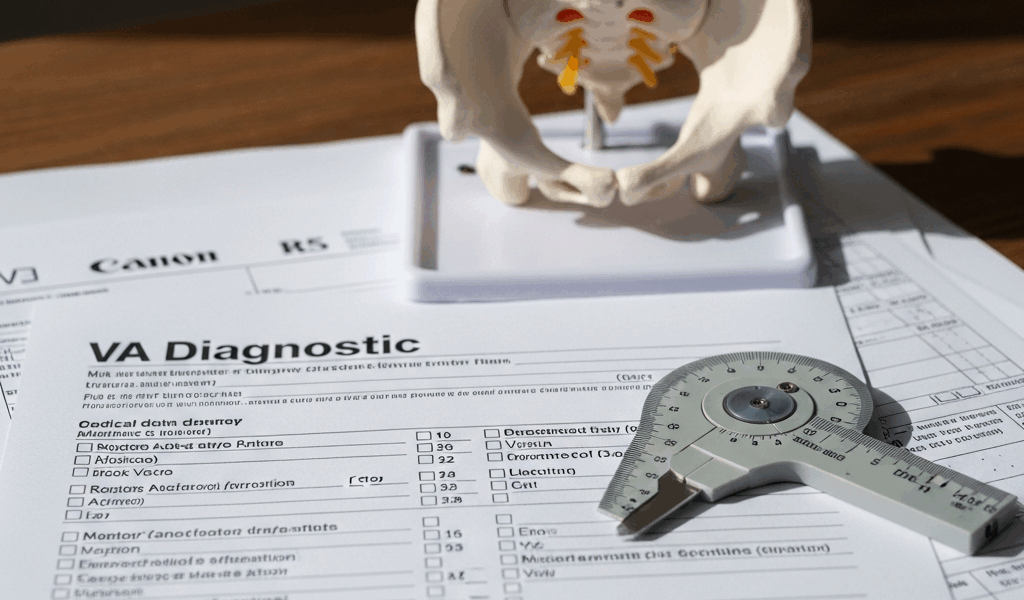
Here’s what catches most veterans off guard — the VA doesn’t actually care what your MRI shows. Bulging disc, degenerative changes, moderate facet arthropathy. None of that drives the rating number. Function does. A C&P examiner uses a goniometer — basically a medical-grade protractor — to measure how many degrees you can bend, twist, and extend. Those degree measurements translate directly into percentages.
Lumbar Spine Ratings (DC 5235)
For lumbar spine conditions, here’s the rating structure tied to range of motion loss:
- 10 percent: Moderate limitation in forward bending or rotation. Combined ROM loss typically lands in the 20–30 degree range from normal.
- 20 percent: Significant limitation. Forward bending restricted to roughly 40–60 degrees — normal is 80 degrees. Pain with activity present.
- 40 percent: Severe limitation. Forward bending down to 20–40 degrees. Recurring pain. Standing and sitting both cause problems.
- 60 percent: Very severe limitation. ROM severely restricted plus objective neurological findings — sciatica, leg weakness, or numbness, all documented in medical records.
Cervical Spine Ratings (DC 5242)
Neck injuries follow similar logic. The measurement math differs because you’re combining forward bending, backward extension, and lateral rotation:
- 10 percent: Mild limitation in rotation or bending. ROM loss of 15–25 degrees.
- 20 percent: Moderate limitation. ROM reduced to 30–50 degrees from normal. Normal combined cervical ROM sits around 120 degrees.
- 40 percent: Severe limitation with documented pain and possible nerve involvement — radiculopathy radiating into the arm.
- 60 percent: Very severe limitation with significant neurological signs.
Probably should have opened with this section, honestly. Your rating depends almost entirely on what the C&P examiner measures with that goniometer. Move too freely during the exam and you rate lower. Fail to demonstrate your actual limitations and you lose money — permanently.
How to Establish Service Connection for Back Pain
Before the VA rates anything, you have to prove three things: a current medical diagnosis, a service-connected event or injury, and a nexus — a medical opinion linking the service event to your current condition. Miss any one of those three and the claim fails, no matter how legitimate the injury is.
Start with VA Form 21-526EZ. It’s on VA.gov and takes about 20 minutes to complete. When it asks about the service incident, be specific. Don’t write “back injury.” Write something like “strained lower back lifting 60-pound ammunition crates during rifle qualification at Fort Bragg, June 2008” — or “sustained blunt trauma to lumbar spine after being ejected from an MRAP during an IED strike, Kandahar Province, March 2011.” Dates, locations, details. All of it.
Next comes medical evidence. VA treatment records showing back pain or imaging done at a VA facility are ideal — the examiner pulls those automatically. But if your injury happened years ago and you never reported it, or if you only ever saw civilian providers, gather those records yourself and upload them with the application. Don’t wait for the VA to find them.
Now the tricky part: the nexus letter. This is a written statement from a physician — your VA primary care doctor works, a civilian doctor works too — connecting your current back condition to the service injury. It doesn’t need to be elaborate. A single paragraph stating something like “Based on my review of [veteran’s] service records and medical history, it is my opinion that his current lumbar strain is at least as likely as not related to the 2008 injury sustained at Fort Bragg” satisfies the requirement. Some VA doctors write these at no charge. Others don’t. A private nexus letter from an independent physician runs roughly $200–$400. Worth every dollar — don’t make my mistake of waiting two years to get one.
No paperwork from the incident? No incident report, no sick call record, nothing? Get a buddy statement. Find a service member who witnessed the injury and have them write down what they remember — dates, location, exactly what happened. It gets signed under penalty of perjury. The VA accepts these. They’re not as strong as medical records, but they beat a gap in the evidence file.
What to Do at Your C&P Exam for a Back Claim
This is where claims get quietly destroyed. A veteran walks in, the examiner asks them to touch their toes, and — nervous, not wanting to seem like they’re faking — they do it without visibly struggling. The examiner writes “ROM within normal limits.” Suddenly a 40 percent claim becomes a 10 percent rating.
Prepare like you’re rehearsing something important. Three days before the exam, run through your actual range of motion at home. Not your best effort. Your honest, painful effort. Where exactly does the pain start when you bend forward? Does it stay in your lower back or does it shoot down your leg? How far can you actually rotate before it stops you? Write it down.
At the exam, move slowly and deliberately. The examiner isn’t just watching the goniometer — they’re watching how you guard the movement, how you brace, whether you wince. If forward bending causes genuine pain at 45 degrees, stop at 45 degrees. Don’t push through it. Your job isn’t to prove toughness. Your job is to honestly show what your body does and doesn’t do.
Mention good days and bad days — explicitly. “Today’s actually not terrible, but most mornings I can barely get out of bed without gripping the nightstand. Sitting for more than 45 minutes usually flares it up for the rest of the day.” The examiner needs your baseline, not your best-case scenario on a Thursday morning when you happened to sleep well.
Bring a written symptom list. Numbness. Tingling. Radiating pain into the glutes or thighs. Difficulty sleeping. Problems with stairs. Can’t stand at the kitchen counter for more than 20 minutes without shifting weight constantly. Write it out before you go — because once you’re in that exam room, anxious, under fluorescent lighting, you will forget half of it.
Stacking Secondary Conditions Like Radiculopathy
Here’s where a back claim can seriously multiply in value. Secondary conditions. If your back injury is compressing a nerve root — which lumbar disc problems commonly do — you’ll develop radiculopathy. Leg pain. Numbness. Weakness. The VA rates radiculopathy separately under DC 5244, which means it adds to your total disability percentage on top of the back rating itself.
The radiculopathy rating structure: 10 percent for mild symptoms, 20 percent for moderate (pain and numbness in the leg), 40 percent for severe (pain, numbness, and weakness affecting your ability to function). That’s what makes secondary conditions so valuable to veterans navigating this system.
Here’s a concrete example. Say you receive 40 percent for lumbar spine and 20 percent for left-leg radiculopathy. The VA doesn’t simply add those numbers together. They run them through the Combined Ratings Table — a calculation where 40 percent and 20 percent combine to 52 percent, which rounds to 50 percent. As of 2024 rates, 40 percent alone pays roughly $737 monthly for a single veteran with no dependents. The 50 percent rate pays around $958 monthly. That’s a $221 monthly difference — $2,652 per year — from one secondary condition being properly documented.
Make sure the C&P examiner documents every radiating symptom you have. Sciatica. Numb toes. Calf weakness when you climb stairs. Tingling that wakes you up at 2 a.m. Say all of it, out loud, clearly. These symptoms support a secondary radiculopathy rating, and that secondary rating meaningfully increases your combined total. I’m apparently someone whose sciatica got dismissed at the first exam because I didn’t say anything — and resubmitting that documentation took eight months. Don’t make my mistake.
Your VA rating for back pain comes down to specific diagnostic codes, measurable range-of-motion loss, and documentation of secondary conditions. File the right form. Gather the right evidence. Show up to the exam ready to honestly demonstrate your limitations — not your good days. Stack the secondary conditions that apply to your situation. Most denied or underrated claims fail because veterans didn’t know these specifics before walking in. Now you do. Use it.




Stay in the loop
Get the latest military plan updates delivered to your inbox.