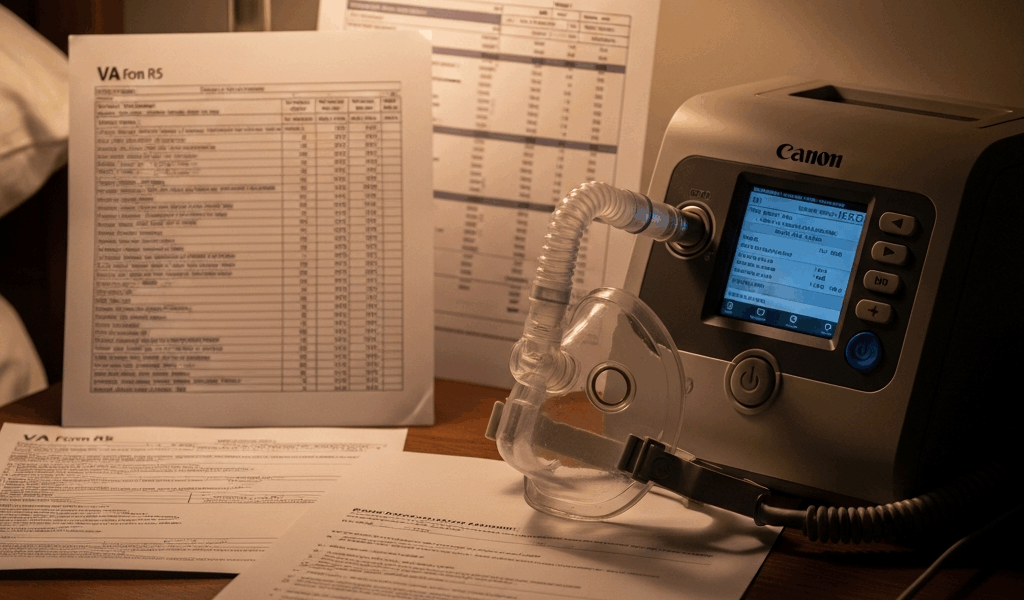
Why VA Sleep Apnea Claims Get Denied
VA sleep apnea claims have gotten complicated with all the conflicting advice flying around.
Sleep apnea has been service-connected for over 240,000 veterans. And yet denials are everywhere. Probably should have opened with this section, honestly, because the reasons claims fail are specific, repeatable, and — here’s the thing — completely preventable.
Three patterns kill most claims before they ever reach a rater. All three are fixable.
No In-Service Diagnosis
The biggest stumbling block is straightforward: nothing in your military medical records shows a sleep apnea diagnosis. The VA isn’t hunting for proof you had it. They want documentation that someone in uniform — or at least a military provider — identified it. A sleep study run at Fort Bragg in 2003 counts. A passing note in a service treatment record counts. A private diagnosis the week after discharge? Doesn’t count. That kills direct service connection claims immediately.
But what is secondary service connection? In essence, it’s a pathway that ties your sleep apnea to a service-connected condition you already have. But it’s much more than that — it’s often the only realistic route for veterans who were never diagnosed during service. PTSD, traumatic brain injury, obesity, asthma. Those are your bridges. Without one, the examiner has nothing to anchor the claim to.
A Nexus Letter That Doesn’t Actually Say Anything
Examiners see hundreds of these letters. Most are garbage. A weak nexus letter reads something like: “In my medical opinion, the veteran’s sleep apnea is likely related to military service.” That’s not a medical opinion. That’s a sentence.
An examiner told me directly — after reviewing my file — that she’d rejected eight nexus letters that same week. The doctors hadn’t reviewed service treatment records. No mention of a specific stressor. No mechanism. Nothing connecting the dots in any medical or physiological way. Just vibes, essentially.
A strong nexus letter names your service-connected condition or stressor. It explains the biological pathway. It references your actual records — not a generic paragraph about veterans and sleep. And it uses the phrase “more likely than not,” which is the VA’s legal threshold. Not “could be related to.” Not “may have contributed.” That language won’t move anything.
No CPAP Prescription or Sleep Study on Record
The VA rates sleep apnea at 30 percent without treatment documentation. To reach 50 percent — where monthly compensation jumps by roughly $575 — you need either a CPAP prescription or objective sleep study results showing moderate to severe apnea. No records, no bump. Many veterans stop here and assume they’re stuck at 30 forever.
Don’t make my mistake. I sat at 30 percent for eighteen months with a CPAP on my nightstand that I used every single night. The VA had no documentation of it. Not the prescription, not the usage data, nothing. One supplemental claim with compliance records moved me to 50. The fix was that simple — and that frustrating in hindsight.
What the VA Actually Rates Sleep Apnea At
Four tiers. Knowing where each one starts and stops is the only way to know whether your rating makes sense.
0 Percent — Not Service Connected
The claim was denied. Sleep apnea exists, but the VA found no link to service. That’s what this rating means — nothing more, nothing less.
30 Percent — Sleep Apnea Documented, Asymptomatic or Mild
Confirmed diagnosis. Sleep study or CPAP settings on record. Either no CPAP use yet, or using one with minimal remaining symptoms. Monthly payment as of 2024 sits around $405. It’s a real number, but it’s not where most veterans should stop.
50 Percent — Sleep Apnea with CPAP Compliance
This is the threshold most veterans miss. Documented CPAP use means prescription records, mask refill history, and — critically — actual usage data pulled from the machine itself. The VA wants proof you’re using it, not just proof it exists in your apartment somewhere.
I’m apparently a ResMed AirSense 10 user, and that machine works for me while an older Respironics unit never tracked data the way the VA needed. Bring your machine’s SD card or compliance report. Monthly payment at 50 percent: around $980.
100 Percent — Sleep Apnea with Severe Comorbidities
Total disability. This rating applies when sleep apnea produces severe symptoms despite CPAP use — daytime oxygen desaturation, hypoxemia, pulmonary hypertension. Rare. Requires extensive medical documentation. Most veterans won’t reach this through sleep apnea alone, but secondary conditions can push a combined rating there.
Building Your Service Connection Evidence
So, without further ado, let’s dive in — because this is where claims actually win or die.
Direct Service Connection
Direct service connection means a diagnosis during active duty or within one year of discharge. Your service treatment records have to show it. A formal sleep study qualifies. A provider’s note mentioning “sleep apnea” qualifies. Even a documented symptom cluster that a military provider flagged can work if the language is right.
Pull everything using VA Form 180. Request records from every base, clinic, and specialty department you touched. Sleep apnea diagnoses sometimes hide in dental records, occupational health files, or flight medicine records — places most veterans never think to check first.
Secondary Service Connection
Secondary service connection is your pathway if direct fails. That’s what makes this option so valuable to us veterans who slipped through without a formal in-service diagnosis — it opens a route that direct connection simply can’t.
The most common links are:
- PTSD — Sleep apnea appears regularly as a PTSD comorbidity. Nightmares and hypervigilance fragment sleep architecture over time. A nexus letter connecting PTSD-driven sleep disruption to apnea development holds up — if the mechanism is spelled out explicitly.
- Traumatic Brain Injury (TBI) — Post-TBI sleep disorders are well-documented. The argument that TBI disrupts the brain’s respiratory control centers is defensible, particularly with supporting literature cited in the nexus letter.
- Service-Connected Obesity — If a thyroid condition, metabolic disorder, or another service-connected diagnosis drove significant weight gain, obesity-linked sleep apnea follows as secondary. The chain needs documentation at each link.
- Asthma or Reactive Airway Disease — Upper airway reactivity can contribute to apneic events. This connection is weaker than the others but has worked, particularly when the service-connected asthma is well-documented and predates the apnea diagnosis.
The Nexus Letter That Actually Works
Here’s what needs to be in your nexus letter — no exceptions:
- The examiner’s credentials and specialty area
- A direct statement: “It is more likely than not that [your name]’s sleep apnea is service-connected” or “…is secondary to [service-connected condition]”
- Your specific service dates, duty stations, unit, and relevant exposures or stressors
- The biological or physiological mechanism linking service to sleep apnea
- Citations from your actual medical records — not boilerplate language recycled from a template
- Explicit notation that “more likely than not” means at least 50 percent probability, meeting the VA’s evidentiary bar
Buddy statements matter here too. Someone you served alongside who can document heavy snoring on deployment, poor sleep during field ops, or witnessed breathing disruptions — that statement, notarized and dated — adds weight a doctor’s letter alone sometimes can’t provide.
How to Prepare for the C&P Exam
The C&P examiner controls your rating more than any other single factor in this process. What gets said in that room shapes everything.
What Examiners Are Actually Looking For
Four things: sleep study severity, CPAP compliance and pressure settings, daytime symptoms, and functional impact on work or daily life. They’re not there to decide whether you deserve compensation. They’re documenting findings — objective and subjective — and writing a report.
Bring your machine data. ResMed AirSense 10, Philips Respironics DreamStation, whatever you’re using — these devices store AHI scores, usage hours, leak rates, and pressure data. The examiner can pull it directly. That data proves compliance and severity at the same time. It’s worth more than a stack of letters.
Describe Your Worst Days, Not Your Average Days
Frustrated by my first C&P result, I went back through my notes and realized exactly where I’d buried my own claim — I walked in and said, “The CPAP helps. I sleep better now.” Technically accurate. Functionally useless for rating purposes.
The exam isn’t about treatment success. It’s about how severe the condition is and what it does to your life. The examiner needs to hear the oxygen saturation number — 82 percent at 3 AM. The mid-afternoon crashes. The shift work you’ve had to turn down because alertness after 2 PM isn’t reliable anymore. The red lights. That’s the information that changes a rating.
Don’t Minimize Your Symptoms
Veterans self-minimize. It’s practically a reflex at this point. But in a C&P exam, downplaying your symptoms is just leaving money on the table. If you’re exhausted, say so. If your memory is unreliable, say that. If relationships suffered, mention it. The examiner isn’t judging your character. They’re logging severity — and they can only log what you actually tell them.
What to Do If Your Claim Was Already Denied
A denial isn’t a verdict. The VA builds the appeals process assuming you’ll use it.
Supplemental Claim — New Evidence Path
File a supplemental claim when you have evidence the original claim didn’t include. New sleep study results, CPAP compliance reports, a stronger nexus letter, buddy statements, service records you’ve since tracked down — all of it qualifies as new and relevant evidence. The VA re-rates the claim without requiring you to re-argue what already happened.
File using VA Form 20-0995. Include a written statement walking the rater through exactly what new evidence you’re submitting and why it changes the outcome. Don’t assume connections get made automatically. They don’t. Walk them through it, explicitly, every time.
Higher-Level Review (HLR)
HLR might be the best option if your evidence is unchanged, as this pathway requires a clear error argument. That is because HLR sends your file to a senior rater to review the original decision — it doesn’t accept new evidence, but it moves faster than a supplemental claim when the first examiner simply got it wrong.
This new appeals structure took effect several years back and eventually evolved into the tiered system veterans navigate today — supplemental, HLR, Board appeal — each one serving a different situation. Know which lane you’re in before you file.
Your next move: pull your VA medical records, identify the three specific pieces of evidence your original claim was missing, and build the supplemental package around those gaps. The rating is claimable — thousands of veterans reach it every year — but you have to show up with the right documentation. That part is entirely in your hands.




Stay in the loop
Get the latest military plan updates delivered to your inbox.